1 College of Information Science and Technology, Eastern Institute of Technology, Ningbo
2 University of Maryland3 School of Computer Science, University of Nottingham
4 The Hong Kong Polytechnic University5 Xi’an Jiaotong-Liverpool University
6 Eastern Institute of Technology, Ningbo
* Corresponding author: Wei Zhang
Same planner. A calibrated command interface.
Direct interfaceObstacle contactGAUGEClear passage
Real robot · fixed DRL-DCLP planner · 1× speed
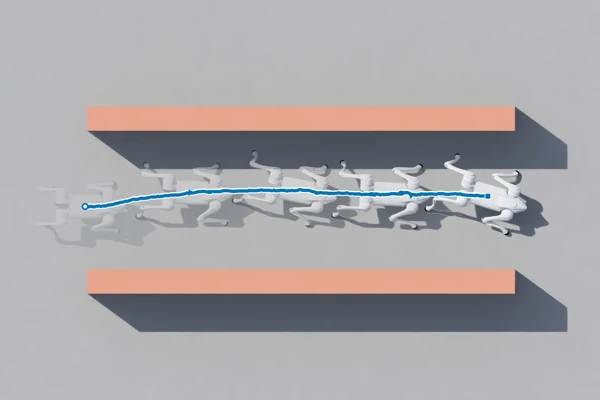
A command–motion mismatch can change obstacle clearance. In this physical demonstration, calibrating the exposed velocity interface changes the observed outcome while the planner and locomotion controller stay fixed.
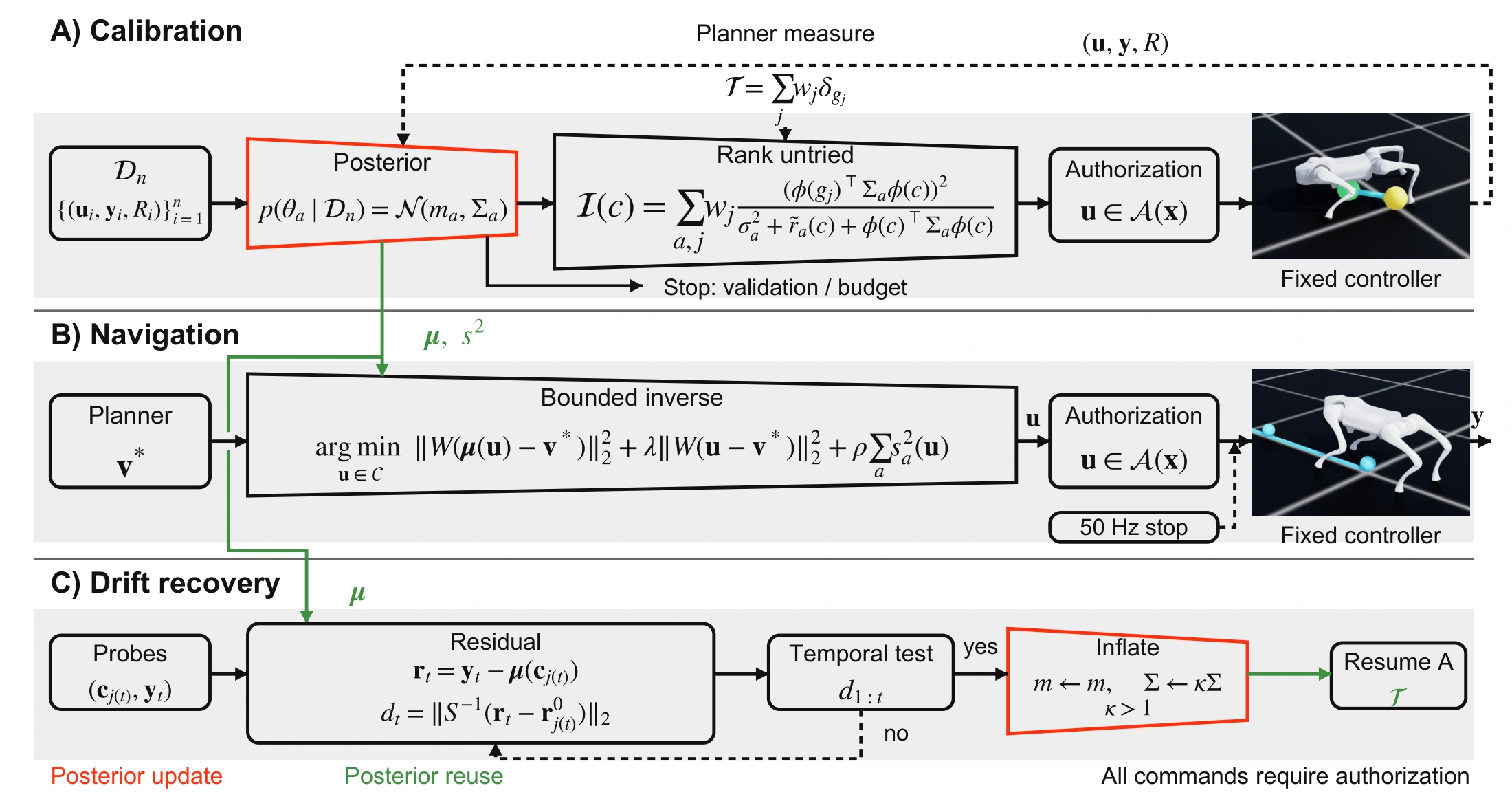
TL;DR Calibrate where the planner acts. GAUGE selects short motion trials to reduce response uncertainty over the commands used by the planner. One posterior supports initial calibration, bounded command compensation, and recalibration after interface shifts.
GAUGE in three minutes
From the command–motion gap to calibration, navigation, and recovery.
English narration and on-screen subtitles. Download video
Calibrate for the navigation task
Commercial quadrupeds accept velocity commands, but their hidden controllers can produce different motion. GAUGE models this external response and directs calibration toward the command distribution of the planner.
01
Active calibration
Rank commands by task-weighted uncertainty reduction. Execute only authorized trials, update the posterior, and stop using fixed validation criteria.
02
Navigation compensation
Use the same posterior to map desired motion to a bounded command. Keep the planner and low-level controller fixed.
03
Post-shift recovery
Retain the posterior mean, expand uncertainty, and reopen task-directed acquisition when the interface changes.
Information value ranks the trials. A separate authorization filter decides whether each command may execute.
Real robot experiments
Short trials calibrate the velocity interface before closed-loop navigation.
Initial calibration · 2× speed
Measure the motion, update the response
Short commands are paired with measured steady motion to fit a coupled Bayesian response model.
Each route-specific deployment uses 6 seed trials + 6 active trials, followed by 8 held-out validation commands.
Unitree Go2 hardware. The clip shows the initial calibration process.
Offset slalom
Repeated turns around offset obstacles · 1× speed
Weighted arc
Sustained turning through the route · 1× speed
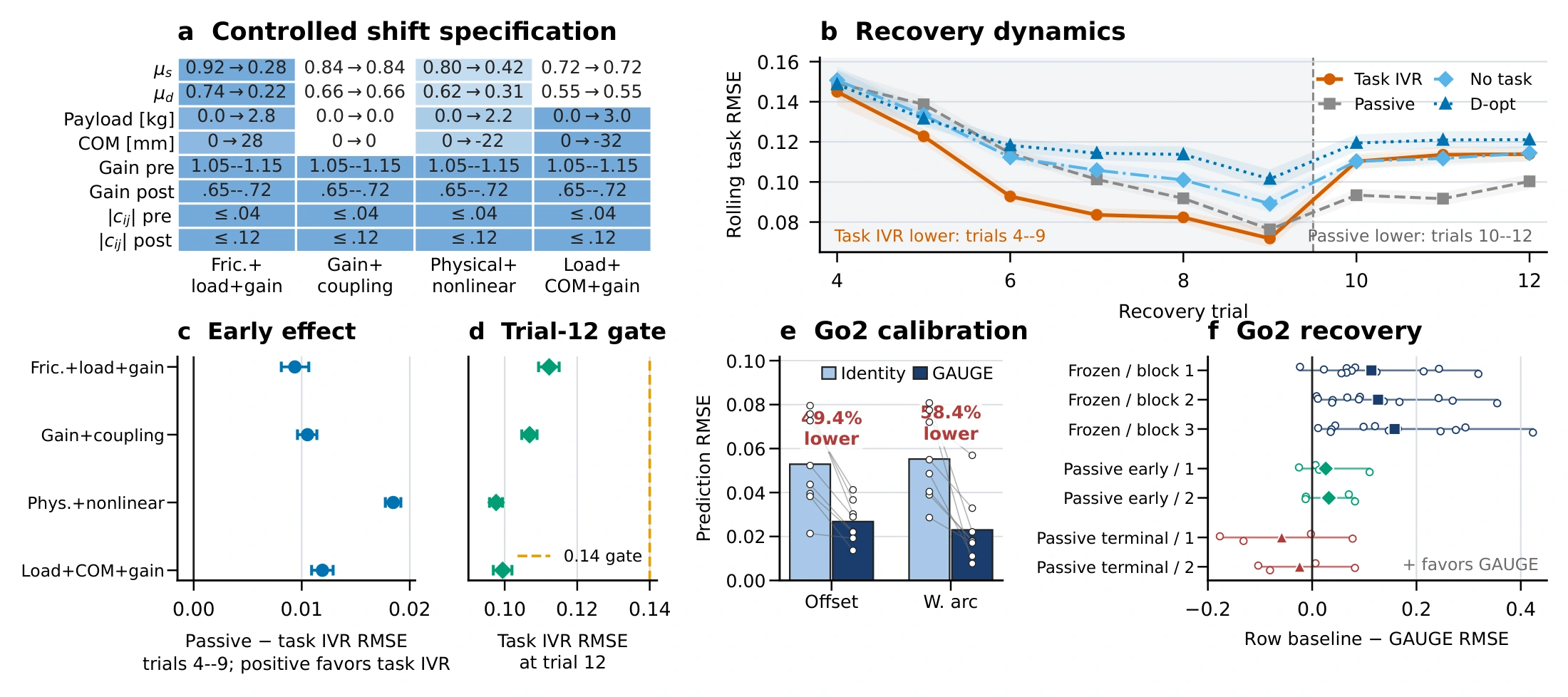
Held-out response-prediction RMSE falls by 49.4% on offset slalom and 58.4% on weighted arc, relative to the identity command map. Each route is fitted independently; these are descriptive results from two deployments.
Simulation results & analyses
Controlled comparisons isolate the benefit of planner-conditioned acquisition.
18.7trials to the joint target20 paired seeds · 3 response families
12 vs. 30calibration trials for navigationGAUGE vs. dense calibration
430 / 432navigation episodes succeed6 held-out maps · zero collisions
Fewer trials where accuracy matters
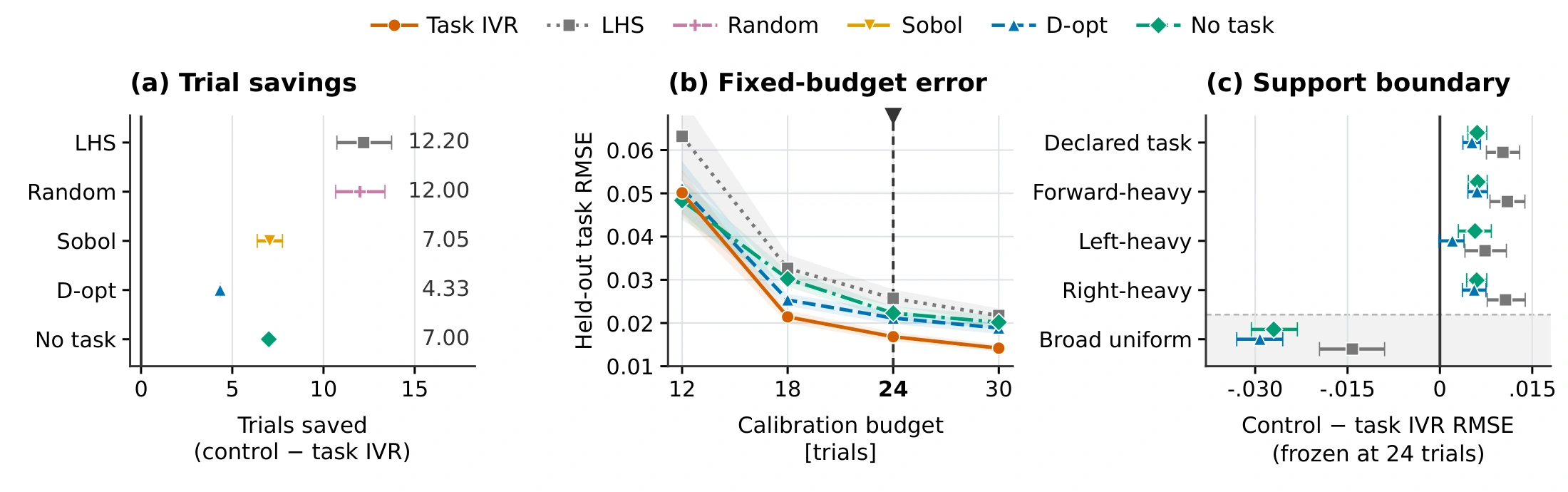
Task-weighted IVR reaches the joint accuracy–uncertainty criterion in 18.7 trials, compared with 23.0 for D-optimal design and 25.7 for task-agnostic IVR. Expanding evaluation to broad uniform command support reverses the ordering: the benefit comes from matching acquisition to deployment.
Three controlled response families, averaged within each of 20 paired seeds. The joint target is RMSE ≤ 0.04 and epistemic variance ≤ 0.0015. Intervals are paired 95% bootstrap intervals.
Restore task-facing accuracy after a shift
The same task-weighted objective guides recalibration. It lowers early recovery error over trials 4–9; passive updating can reach lower error at the final budget. A scheduled gain-and-coupling change on hardware exhibits the same early-versus-terminal trade-off in the two complete paired blocks.
Simulation evaluates residual-triggered recovery. Hardware recovery uses a scheduled, known interface change; physical effects are descriptive.
Navigate with a smaller calibration budget
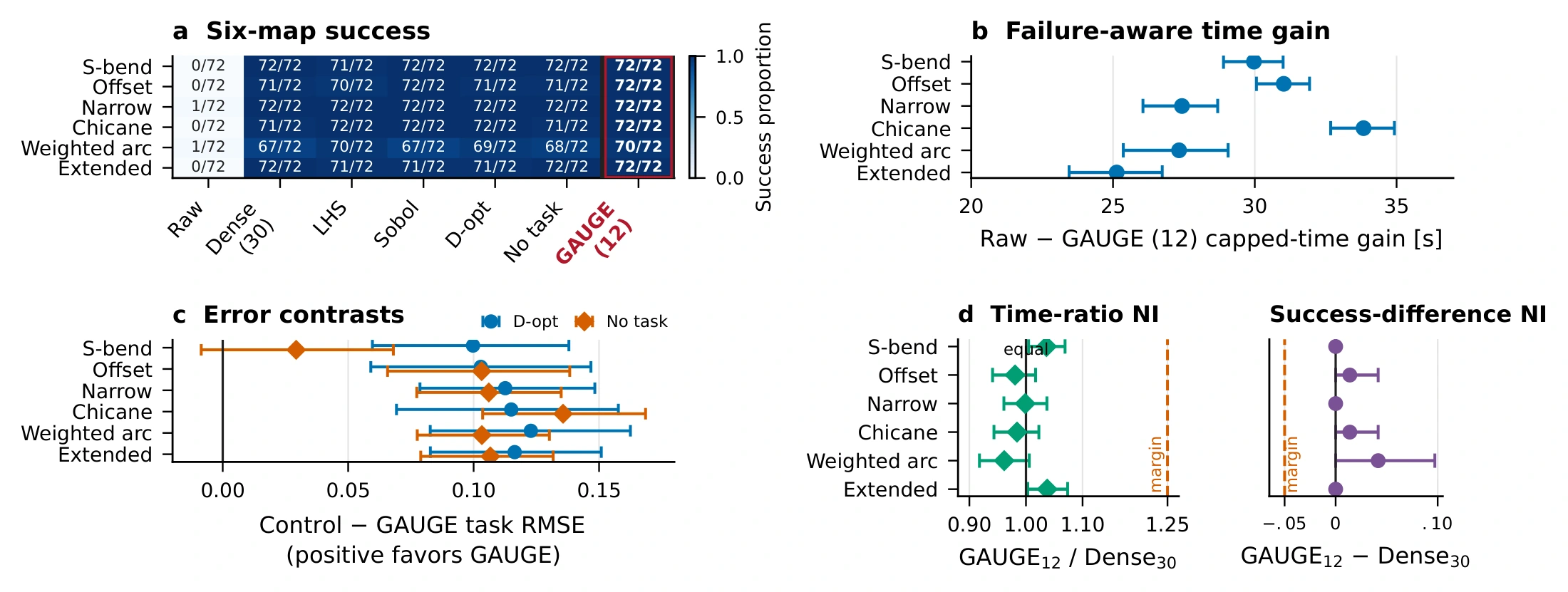
Across six held-out Isaac Sim maps, a 12-trial GAUGE fit meets the declared navigation noninferiority margins against a 30-trial dense reference. Both receive 8 common validation commands.
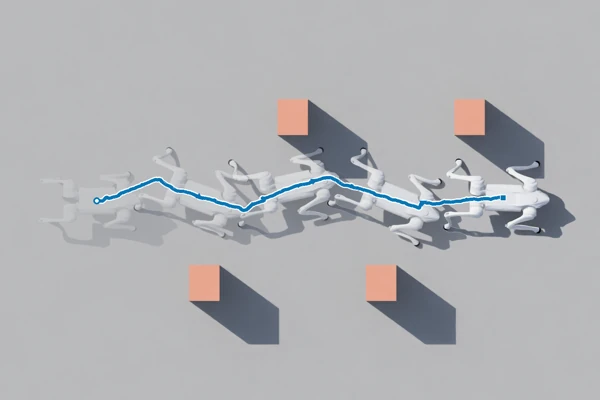
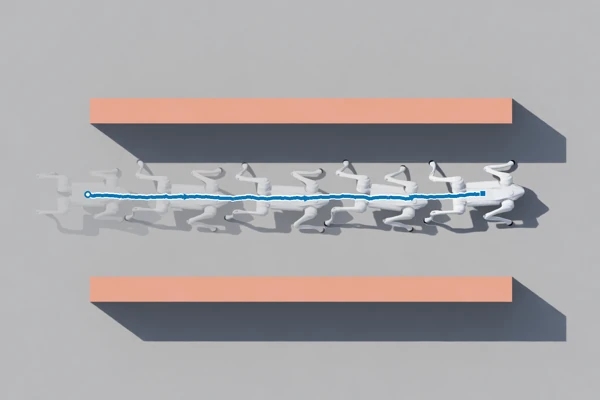
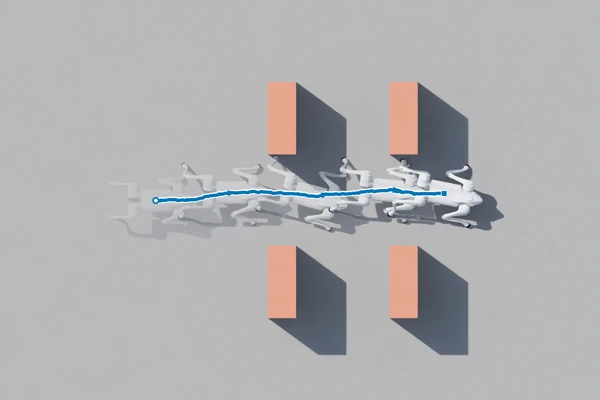
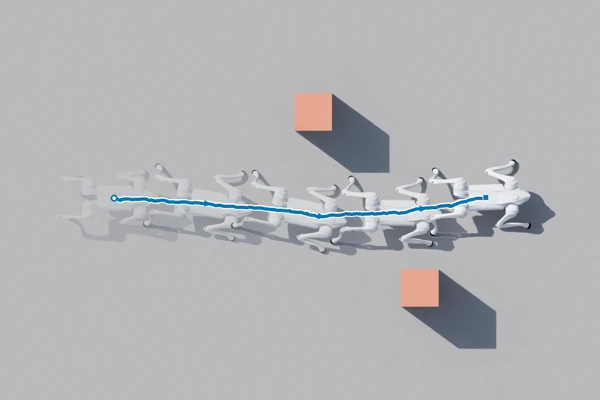
S-bendOffset slalomNarrow laneDouble chicaneWeighted arcExtended lane
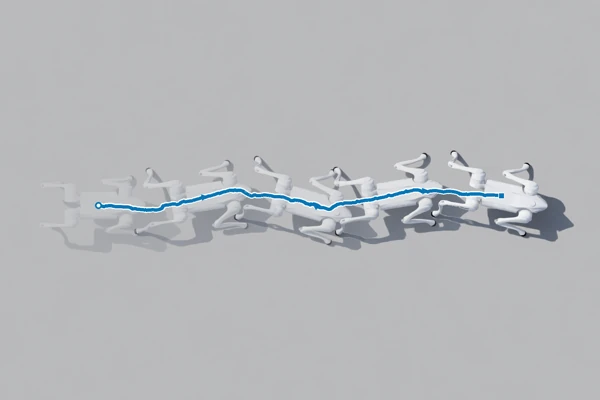
72 paired seeds per map. Noninferiority margins: capped-time ratio ≤ 1.25 and success difference ≥ −0.05. Blue curves above show executed trajectories; robot opacity increases with time.
Abstract
In this paper, we present a Goal-Aware Uncertainty-Guided Exploration (GAUGE) framework for planner-conditioned active calibration of opaque quadruped velocity interfaces. Commercial quadrupeds commonly expose planar-velocity commands, but the underlying locomotion controller remains inaccessible and can produce systematic discrepancies between commanded and realized motion. A navigation planner typically uses a structured subset of the command envelope. GAUGE maintains a Bayesian command-to-motion model and selects authorized trials according to their expected reduction of posterior epistemic uncertainty under the planner-induced command distribution. The resulting posterior supports validation-based stopping, bounded inverse compensation, and task-relevant recalibration after detected interface shifts. In three controlled response families, GAUGE reaches the joint criterion for task-facing accuracy and uncertainty with fewer trials than passive, D-optimal, and task-agnostic alternatives. Across six held-out Isaac Sim navigation maps, it meets the declared noninferiority margins against dense calibration. Code is available at github.com/EurekaZang/CalibAgent.
Citation
@misc{zang2026gauge,
  title  = {GAUGE: Planner-Conditioned Active Calibration of
            Opaque Quadruped Velocity Interfaces},
  author = {Tianhao Zang and Zihan Liu and Shanze Wang and
            Liyou Luo and Xingjian Xie and Chengtai Li and Wei Zhang},
  year   = {2026},
  url    = {https://eurekazang.github.io/CalibAgent/}
}